 Physix Frontier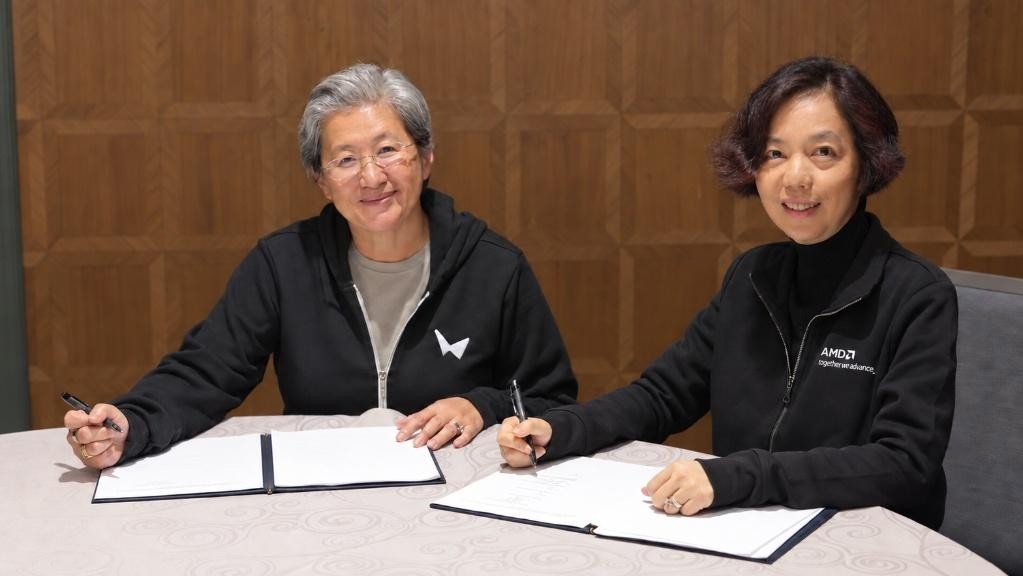
Lisa Su Buys Fei-Fei Li for $8.2B in All-Stock Deal: The Pure-Software Era of Large Models Is Over, Killed Off by Chipmakers

By Deep Frontier Observation Feature · September 29, 2026 · Field: Physical AI / World Models / Integrated Compute Hardware-Software
While the whole industry is still debating when large model applications will turn a profit, and cloud vendors are driving the per-token price war down to fractions of a cent, chip giant AMD just used an $8.2 billion (roughly 58 billion RMB) check to completely rebuild the competitive coordinate system of cutting-edge AI in Silicon Valley.
On September 28 US time, AMD officially announced that it had signed a definitive acquisition agreement with AI startup World Labs. World Labs, co-founded just two years ago by "Godmother of AI" and Stanford professor Fei-Fei Li, will be absorbed into AMD entirely through an all-stock transaction. Even more telling as a bellwether: Fei-Fei Li will directly serve as AMD Executive Vice President and Chief Scientist, reporting directly to AMD Chair and CEO Lisa Su.
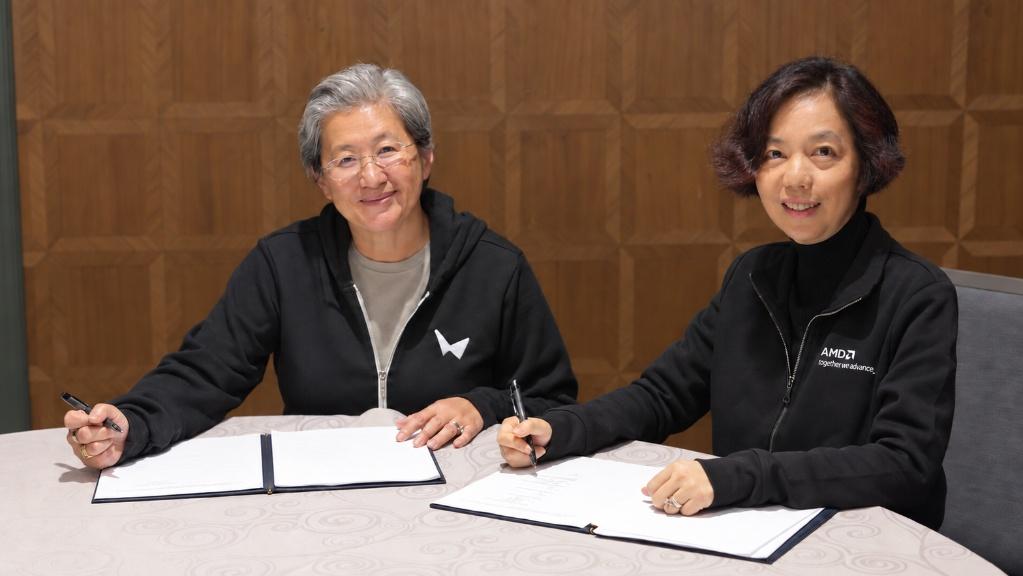
*
Caption: Lisa Su (left) and Fei-Fei Li (right) at the agreement signing. Fei-Fei Li formally joins wearing a jacket bearing AMD's 'together we advance_' slogan.*
After the news was announced, Lisa Su immediately posted a pinned tweet on X:
"Very happy to welcome World Labs and Fei-Fei Li to the AMD family! I've always been a huge fan of Fei-Fei and her pioneering AI research. We will combine World Labs' deep expertise in AI and world models with AMD's compute leadership to jointly drive the future of AI and strengthen the open-source ecosystem."

*
Caption: @LisaSu on X officially confirms the post and engagement data; the single tweet quickly surpassed hundreds of thousands of views.*
At the same time, Fei-Fei Li published a long essay in her personal column titled "To Seek a Newer World," laying out the fundamental logic behind this turning point: "This world is not made of words, but of real physical entities. From the very beginning of World Labs, we believed that language alone is not enough to build true general intelligence."
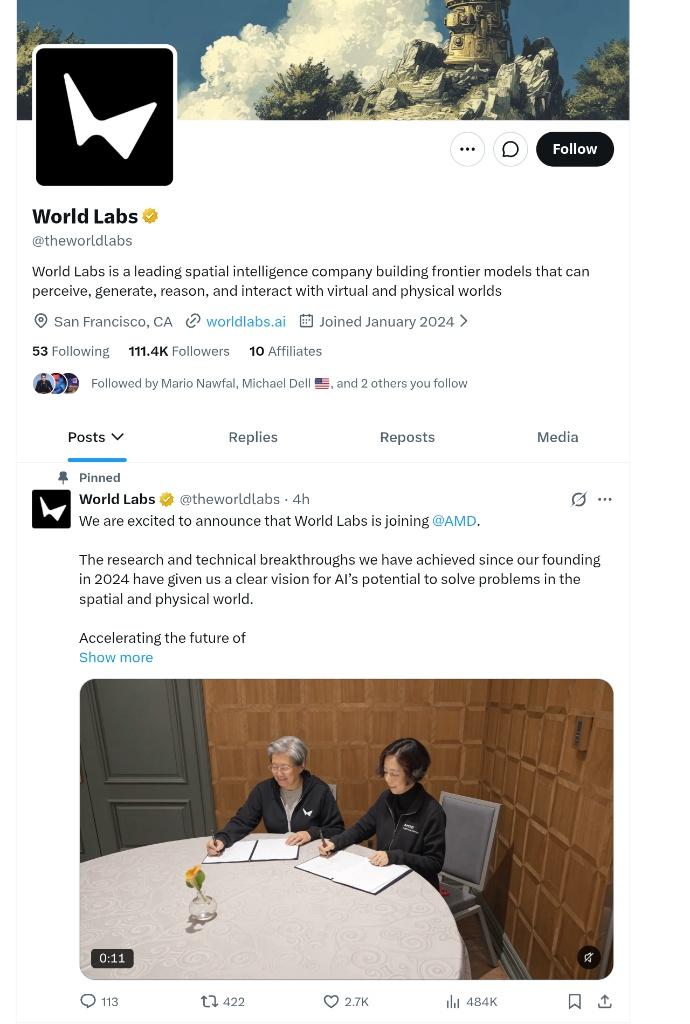
*
Caption: @theworldlabs on X official account pinned tweet, announcing that the entire lab team will join hands with AMD to advance spatial intelligence and interaction with the physical world.*
Founded in early 2024, World Labs gathered top global vision and 3D scholars such as Fei-Fei Li, Justin Johnson, and Ben Mildenhall in just two years. Many people's first reaction was curiosity: why didn't Fei-Fei Li go independent all the way to an IPO like other unicorns, but instead chose to sell herself to a chip hardware company on the eve of the world model commercialization explosion?
The answer is actually written in a remarkably cold judgment by Fei-Fei Li quoted in the Financial Times headline:
"without a focused hardware, AI is hobbled in efficiency."
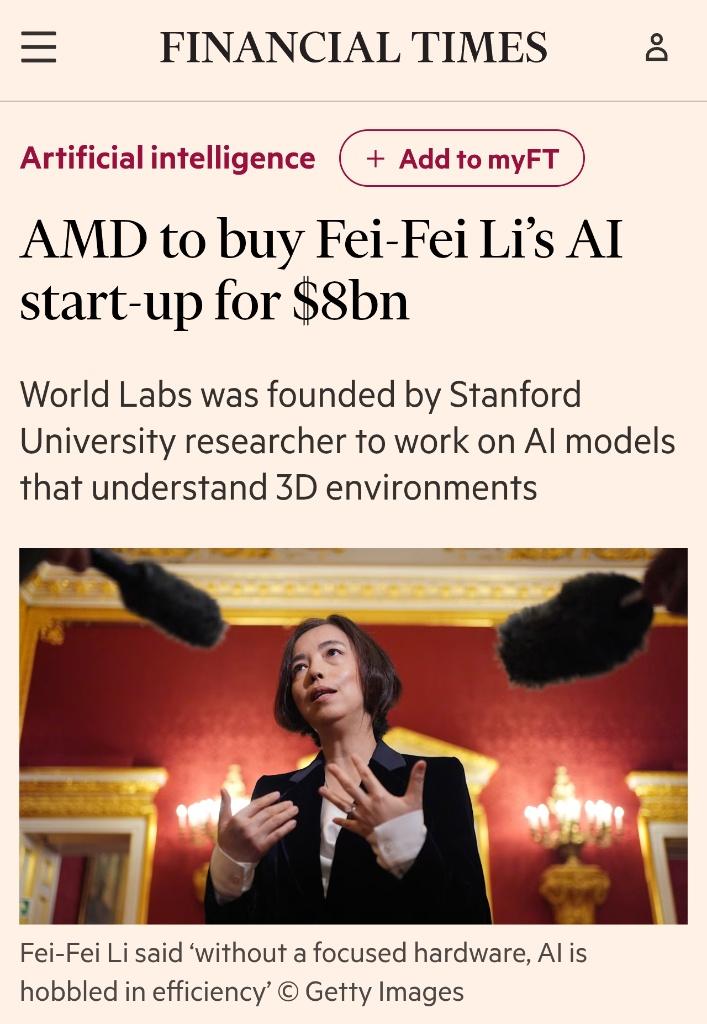
*
Caption: Financial Times headline highlights Fei-Fei Li's core view: detached from a custom hardware foundation, frontier models will be throttled by the shackles of efficiency.*
I. The Physical Ledger Under the Compute Wall: The Survival Limit of a Pure-Software Lab
Over the past three years, the essence of large language models (LLMs) has been "probability prediction over one-dimensional text sequences." Even the later text-to-image and text-to-video tools derived from them are still essentially diffusion fitting on a two-dimensional pixel plane.
But the "Spatial Intelligence and physical world models" that Fei-Fei Li is betting on are, from the underlying mechanism, an entirely different order of engineering magnitude:
1. Geometric explosion in spatial dimensions: world models require AI to natively understand 3D point clouds, depth topology, six-degrees-of-freedom motion collisions, the causal laws of gravity, and lighting continuity.
2. The death sentence of latency in real-time interaction: if a text model generates half a second slower, users can wait, but if a spatial model controlling a physical robot incurs hundreds of milliseconds of memory bandwidth latency when inferring a 3D environment, a robotic arm will directly smash the workpiece, and autonomous driving will instantly lose control.
Open the financial books of any independent physical AI startup and you will find a desperate reality: if you are only a pure-algorithm, pure-software company, facing such terrifying high-dimensional spatial tensor computation, every day you wake up you have to pay cloud giants astronomical GPU rental fees. Even if a world model startup raises hundreds of millions of dollars in equity financing, more than 70% of that cash ultimately just turns into electricity bills, cooling costs, and server depreciation in cloud data centers.
Fei-Fei Li's extreme clarity lies in this: she already pushed open the door of deep learning single-handedly with ImageNet back in 2009; and today, she understands better than anyone that without specialized co-design of underlying chip microarchitecture, high-speed interconnect topology, and instruction sets, physical world models simply cannot achieve a tolerable unit economics model on the industrial and commercial side.
What she wants is not cash—this deal is all-stock. What the World Labs team gets is the highest privilege of diving directly down to the very bottom of AMD GPU wafers and microarchitecture, reverse-customizing hardware compute units according to the algorithmic needs of spatial models.
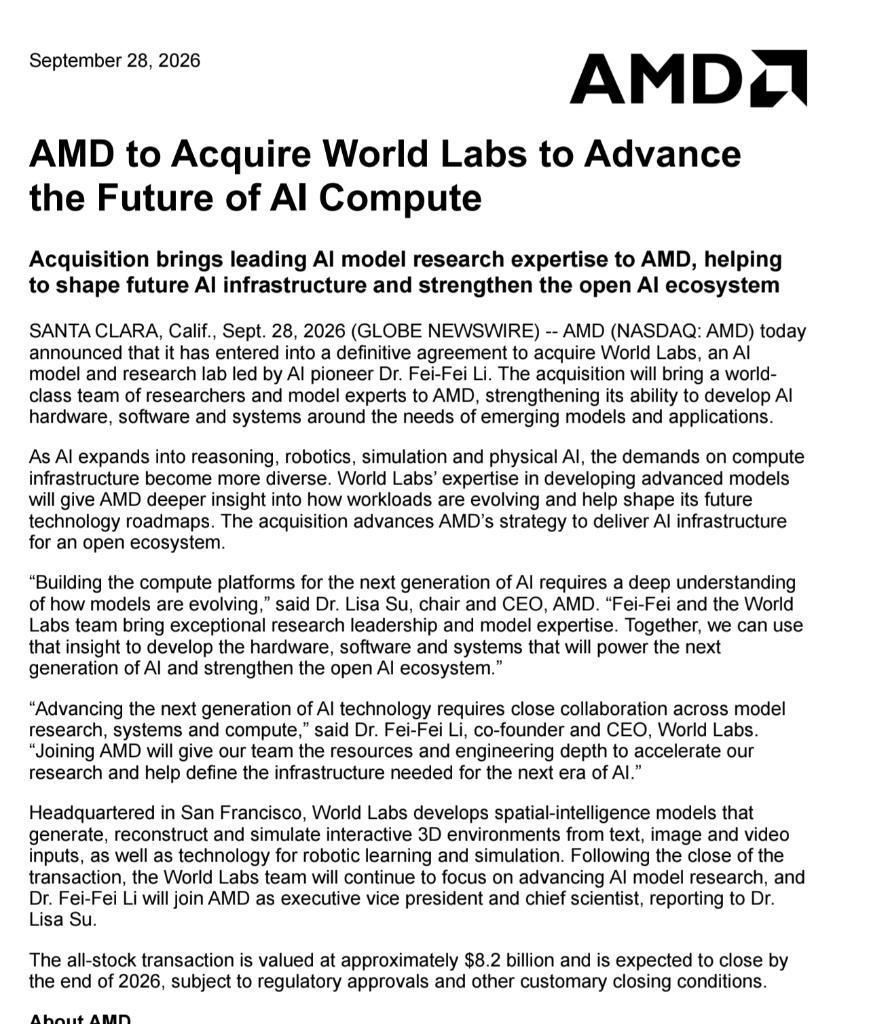
*
Caption: AMD's official announcement confirms the $8.2 billion all-stock transaction terms, with Fei-Fei Li reporting directly to Lisa Su.*
II. Lisa Su's Calculation: Not Just Buying a Model, but Buying a "Soul" for AMD Chips
Now look at the buyer's perspective, AMD. On the data center and large model compute battlefield, AMD's MI300 and MI350 series chips are already enough to challenge Nvidia's hardware in memory capacity and floating-point peak performance. But on the ecosystem dimension, Nvidia has a CUDA software stack that has built a monopoly wall over more than a decade, and in physical AI it laid out early with the Cosmos model system, the Isaac robotics compute suite, and the Omniverse physics simulation platform.
Lisa Su must face a cold reality: if AMD is merely a "cost-effective GPU hardware seller," then once developers get used to Nvidia's full toolchain from algorithm models to physical simulation, AMD's hardware cost-performance advantage will quickly be erased by ecosystem stickiness.
By spending $8.2 billion in stock to buy World Labs, Lisa Su completed a textbook-level strategic reinforcement in this century-defining semiconductor war:
1. Top-tier rallying power and a clarion call for open source: Fei-Fei Li's global academic prestige in computer vision and artificial intelligence is unmatched. Her joining directly sends the strongest signal to top researchers worldwide—AMD is no longer just a chip hardware maker, but a major center of global frontier AI science, capable of directly driving top talent to migrate toward the ROCm open-source ecosystem.
2. The core lever of hardware-software co-design: put world model inventors like Fei-Fei Li at the same table as AMD's underlying chip architects, so that before the next-generation chip is even taped out, hardware-specific acceleration units are designed directly around 3D spatial computing.
3. Defining the next-generation physical compute standard: as the flames of the large model war spread from the virtual digital world to embodied robots, autonomous driving, and smart manufacturing, AMD now has its own "official foundation for world models," directly breaking Nvidia Cosmos's first-mover monopoly.
III. Industry Reshuffle: The Era of Pure-Software Large Model Solo Play Is Completely Over
This blockbuster $8.2 billion acquisition is not only a joining of hands between two top Chinese tech leaders, but also rings three deafening alarm bells for the entire industry:
1. The end of startups built on text prompts and pure wrapper applications: the pattern of large language models as the foundation for cognitive reasoning is set. Continuing to pour heavy money into prompt packaging and simple text dialogue no longer shows any possibility of producing new hundred-billion-dollar giants. The real watershed for the next generation of AI lies in who can understand and intervene in the physical real world.
2. The hardest-edged clarity of scientist entrepreneurship: from the initial academic breakthrough, to founding the company, to financing, and then to a perfect merger into a hardware giant at an $8.2 billion valuation, Fei-Fei Li has taught all frontier AI scientists a very high-level business lesson—in the face of the high wall of compute-heavy assets, stubbornly clinging to pure-algorithm independence often turns you into a passerby for cloud vendors; while the heights are high, deeply binding yourself to the compute foundation is the highest state of technology landing.
3. The compute race upgrades from "shovel seller" to "ecosystem nest builder": future semiconductor giants will no longer have an absolute moat based solely on wafer process and transistor stacking. Only whoever owns the algorithmic brain that defines the next generation of physical intelligence can etch the most lethal compute logic onto silicon.
Sixteen years ago, Fei-Fei Li used ImageNet to tell the world: massive labeled data can let algorithms understand a picture; sixteen years later, standing beside Lisa Su, she uses the choice of an $8.2 billion all-stock deal to tell the whole industry: for AI to truly reshape the physical world, chips and algorithms must become one.

